
2026-05-28
In May, our Birthday Campaign put the basic service PID4NFDI in the spotlight. In the summary below, you can find out more about the PID Coordination Hub, the service’s community engagement and their provided resources.
PID Coordination Hub
It’s common sense that Persistent identifiers (PIDs) are central to FAIR research data management. However, different disciplines and different resources result in diverse requirements and the various NFDI consortia have different levels of maturity in PID implementation. To overcome these differences, PID4NFDI aims to enhance PID integration within NFDI consortia, considering varying provider maturity levels and community adaptation. Their aim is to foster the impact of PIDs by improving metadata quality and interoperability through technical, organisational, and strategic measures.
The service brings together the extensive expertise of various organisations, which jointly run PID4NFDI together: DataCite, the Gesellschaft für wissenschaftliche Datenverarbeitung mbH Göttingen (GWDG), the Helmholtz Open Science Office and the TIB – German National Library of Science and Technology.
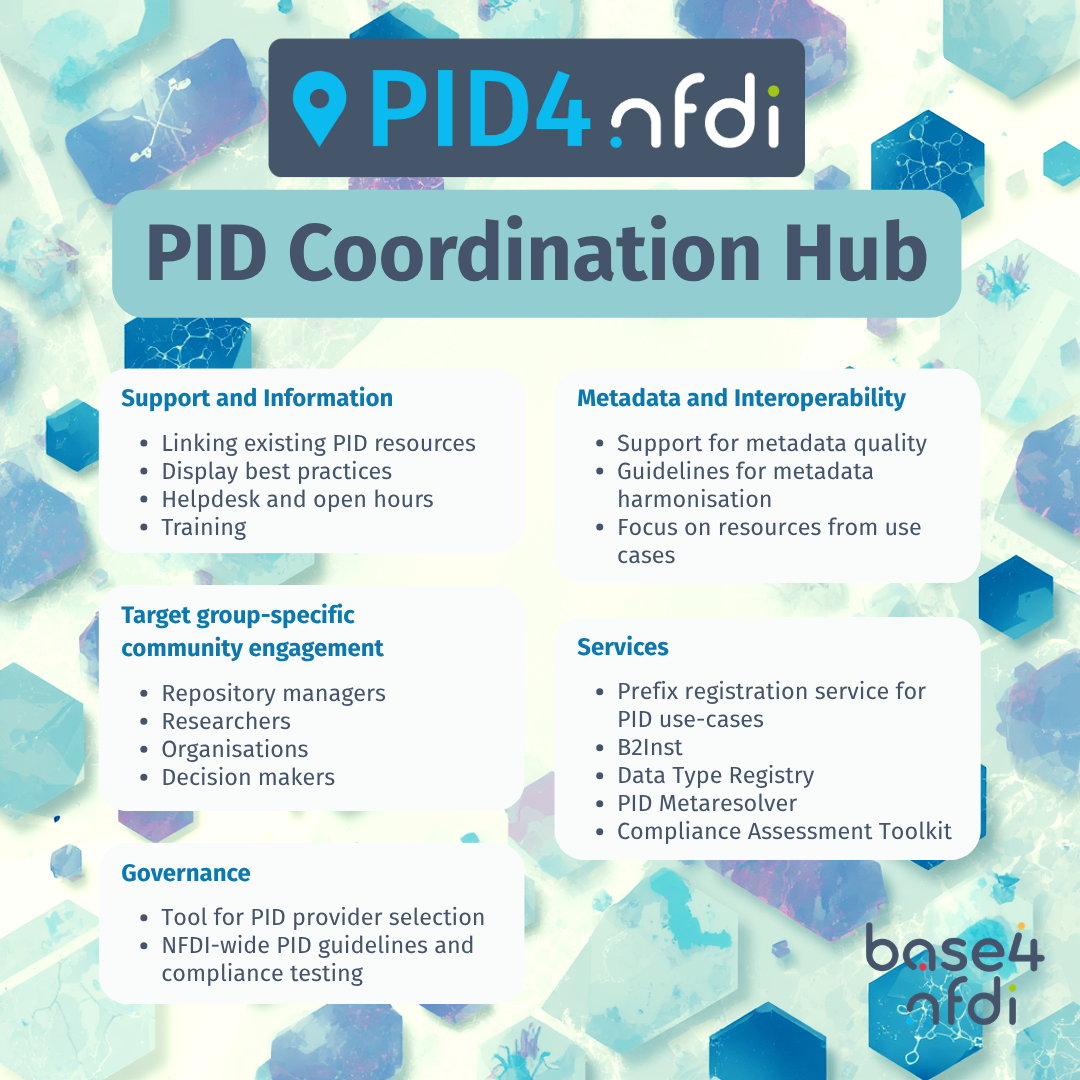
At the very centre of the service of PID4NFDI is the PID Coordination Hub. It serves as a central support infrastructure for managing persistent identifiers within Germany’s National Research Data Infrastructure (NFDI). On its platform, the Hub provides consulting and practical support in the key areas of persistent identifier implementation, interoperability, governance, training/support, and community engagement. It serves as a central entry point for users of the PID4NFDI service portfolio and aims
- to enable repository managers to optimise the integration of PIDs into their workflows,
- to support trainers in the FDM field with materials and information,
- to demonstrate to researchers, decision-makers, and funders the added value of PIDs for their own workflows and processes,
- to provide best practices for different use cases to NFDI multipliers like sections and working groups.
The goal of the interoperability aspect is to ensure that different PID systems, repositories, metadata schemas, and research infrastructures can work together cleanly across disciplines and platforms. It offers support for metadata quality, guidelines for metadata harmonisation, and focuses on resources from already existing use cases.
The metadata key area concentrates on metadata quality, standardisation, and includes practical guidance and services to help repositories improve their metadata maturity. Since the hub does not aim to become a new PID registration agency itself, it also helps to address government issues. It coordinates and simplifies access to existing PID ecosystems and provides helpful policies and recommendations. More materials and recommendations are managed in the areas of training, support and community engagement. There you can find a wide range of training materials, guides, tutorials, use cases, best practices and more as well as information about events and opportunities for consultations.
As you see, the PID Coordination Hub is a multifaceted and complex tool designed to support the entire NFDI community with regard to PIDs, and it will be continuously developed.
Community Engagement
PID4NFDI does not only provide information about persistent identifiers (PIDs), but also helps researchers and consortia to apply them in practice and to build a connected support network around them. On their website you can find a broad overview of PID4NFDI’s community work from real-world use cases, thematic focus groups, open support formats, and services tailored for NFDI consortia. To increase visibility, and facilitate networking, the service offers also an overview of the PID services provided by the NFDI consortia.
PID4NFDI is currently in the integration phase, which is expected to be completed by the end of the year. The goal of the integration phase is to further develop the service into a mature and functional solution that will have been adopted by an initial group of organisations and institutions for their day-to-day operations.
You can see an overview of the consortia with which PID4NFDI has already set up collaborations under Use Cases. The Use Cases are practical examples of how PID4NFDI persistent identifier services can be applied in research workflows. It helps visitors understand where persistent identifiers add value in everyday scientific practice, especially when they need to improve findability, interoperability, and long-term access to research outputs.
In addition to the use cases, the service has established two focus groups in 2025 to discuss the integration of persistent identifiers (PIDs) into the research data lifecycle through data management plans (DMPs) and electronic lab notebooks (ELNs). Each group held three virtual meetings from spring through summer, culminating in a joint in-person workshop in Berlin in September 2025. This report summarizes findings on metadata workflows, PID integration pathways, and technical interoperability requirements. These findings establish a foundation for two incubator projects that will launch in 2026 in collaboration with TS4NFDI.
If you're looking to connect with PID4NFDI in a different setting, you can use two additional formats under “Support”: The Open Hour and the Consultation Hour.
The Open Hour is an informal gathering where the project invites you to learn more about its mission. It is an opportunity to foster engagement and interact with the project in a casual, drop-in manner. During the Open Hour, the project’s work is showcased, and the community is engaged. The Open Hours are designed to be accessible to everyone, regardless of background or connection to the project.
The events are held on a regular basis at different times on different days. Information about the upcoming meetings in 2026 can be found on the PID4NFDI website.
Furthermore PID4NFDI offers you 1:1 consultations sessions to explore PID-specific challenges related to your service and/or use case. The consultation hour offers a tailored approach to address your requirements. Please use the contact form to ‘book’ a consultation hour with PID4NFDI. Inquiries should contain 3 date options for meeting time.
As you can see, PID4NFDI values communication with the community highly in order to understand and support its needs and technical requirements. In addition to their support services, we would also like to highlight two upcoming workshops:
PID4NFDI Community workshop on IGSN Use Cases
Date: June 04, 2026
Time: 10:00 AM to 1:00 PM (CEST)
Registration
The International Generic Sample Number (IGSN) is a globally unique and persistent identifier (PID) for physical objects—ranging from rock samples and sediment cores to biological specimens and cultural heritage objects. This event brings together colleagues from NFDI consortia who are already actively using IGSNs and those planning their implementation. The goals are:
- Community Exchange: Share hands-on use cases and foster networking between different research domains.
- Service Overview: Get an update on available IGSN services and existing infrastructures.
- Shaping Resources: Provide direct feedback on current training materials and guidance documents.
- Future Collaboration: Identify community needs and discuss future formats for structured exchange.
Online Workshop: Building Confidence with Research Metadata at Scale
Date: June 15, 2026
Time: 10:00 AM to 12:00 PM (CEST)
Registration
This hands-on, online workshop empowers research support professionals to move beyond static views of metadata and actively interrogate, assess, and act on DOI metadata at scale using the DataCite API. Using the DataCite metadata schema as a practical reference point, participants will work directly with real DOI metadata to explore which metadata elements most strongly influence discovery, reuse, trust, and decision-making. While DataCite is used as a reference implementation, the approaches and principles discussed are applicable to other PID-based and metadata-rich infrastructures.
Resources provided by PID4NFDI
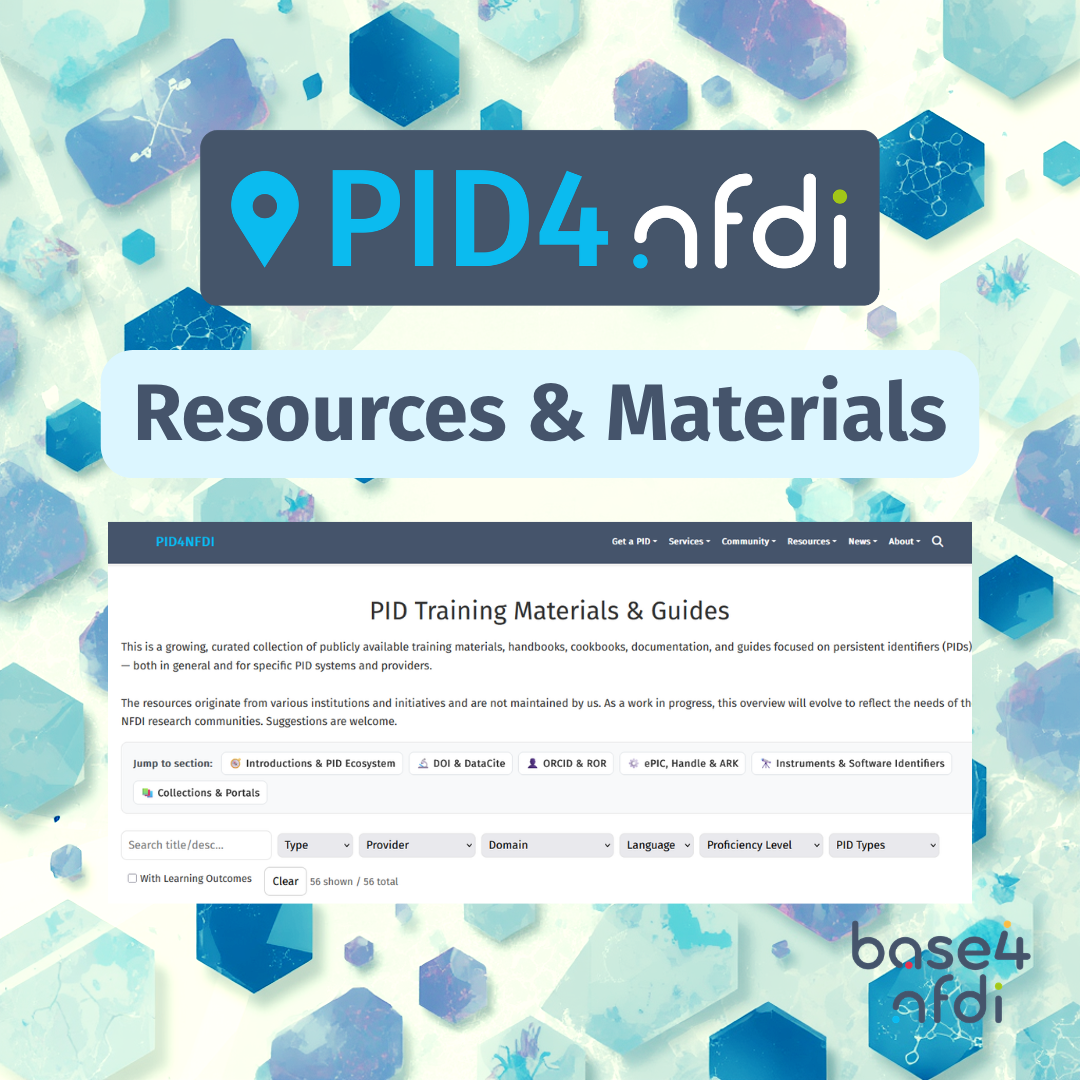
The PID Training Materials & Guides page provides a valuable collection of resources in one convenient place. It points to publicly available handbooks, cookbooks, documentation, and guides from different institutions, with the aim of helping users find reliable PID-related training material in one place. The collection will keep growing to reflect the needs of the NFDI research communities. The team welcomes suggestions.
The materials are sorted in six sections:
- Introductions, Overview & PID Ecosystem
- DOI & DataCite
- ORCID & ROR
- ePIC, Handle & ARK
- Instruments & Software Identifiers
- Collections & Portals
For better findability, additional filter options like type of resource, provider, domain, language, proficiency level and PID type are available to help you to find the right training resources for your matter.
In addition to the training materials, PID4NFDI also provides an overview of their most relevant Publications. For a full and comprehensive list of all their research outputs, you can browse through PID4NFDI’s Zenodo Community. In addition to their own outputs, the service also maintains the PID4NFDI Zotero Library — a publicly accessible, collaborative reference collection on Persistent Identifiers and FAIR Research Data Management. This shared knowledge base curates scholarly articles, reports, and guidelines from across the PID ecosystem.
As you can see, the team of PID4NFDI put a lot of effort into collecting and providing useful resources about the usage of PIDs. All this extensive knowledge was condensed in the PID4NFDI Cookbook. This resource supports you in getting started with PID registration and usage. Besides practical guidance on first steps for individuals and organisations how to implement PIDs in their workflows, it also provides information about what PIDs are, their importance in ensuring long-term access and citation of digital resources, and how they help in maintaining research data, publications, and other digital assets.
In the former posts, you have learned that the service aims to enhance PID integration within NFDI consortia, considering varying provider maturity levels and community adoption. Therefore PID4NFDI developed the PID Coordination Hub as a central entry point for users of the PID4NFDI service portfolio. Last week we showed you a broad overview of PID4NFDI’s community work from real-world use cases, thematic focus groups, open support formats, and services tailored for NFDI consortia. Today, we would like to shed some light on the training materials and publications of PID4NFDI.
We hope these posts have made it clear that PID4NFDI is the perfect point of contact for any questions you may have about using PIDs. Grab a coffee and browse through the wealth of resources. If you still have questions after that, the team is here to offer help and advice. Feel free to take another look at last week’s article with information about their community engagement.