
Base4NFDI Birthday Campaign - September 2026

Banner for Base4NFDI Birthday Campaign in September

2026-09-22

Over the past few months, we’ve shown you that our basic services are doing a great deal to engage with their users and respond to their needs. But it’s not just the services – Base4NFDI is also making a real effort to work closely with its community. In September, we’ve informed about a few of our community events and how we’re staying in touch with our community.

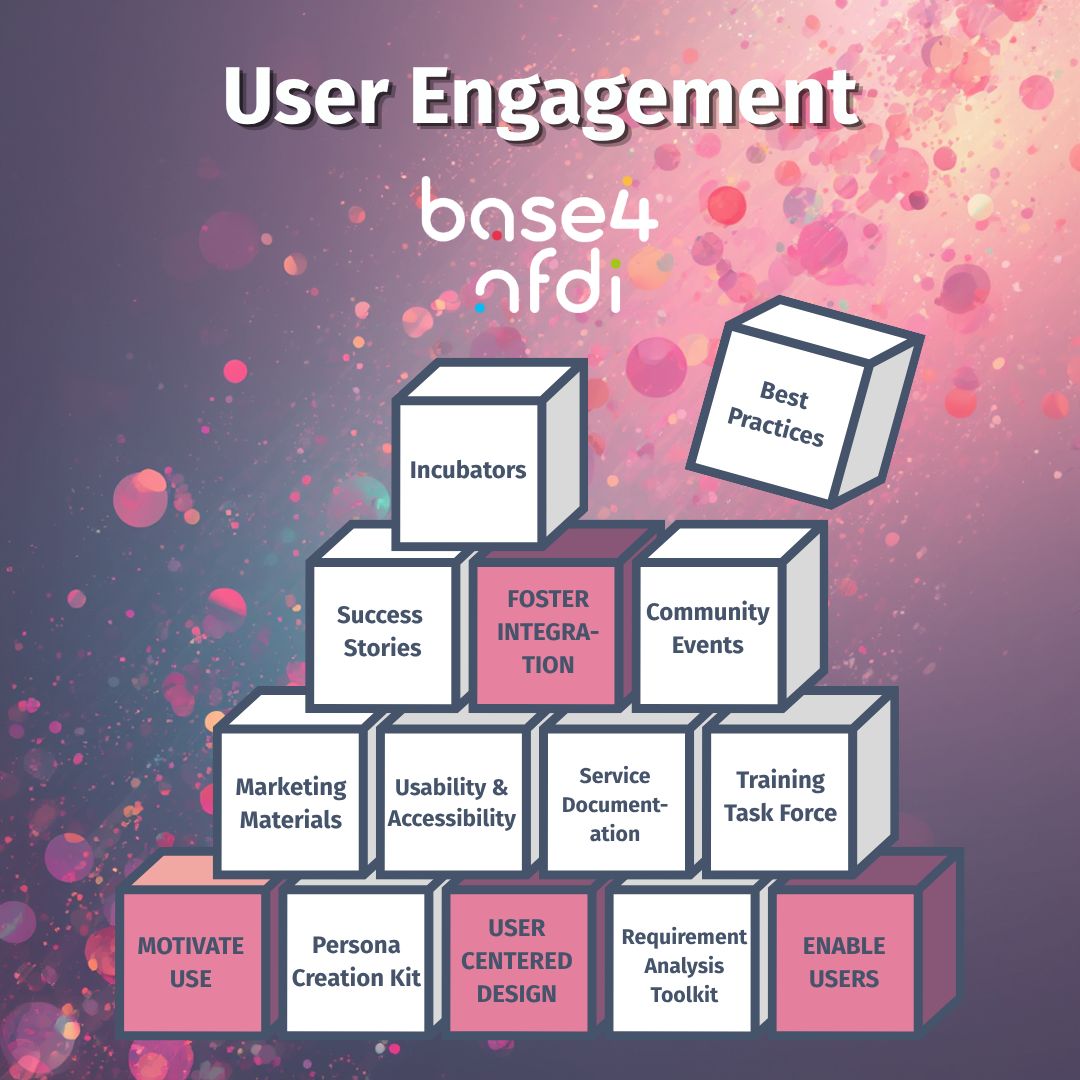
Base4NFDI User Engagement

User engagement is a central element of Base4NFDI. As the basic services supported by Base4NFDI cover a broad range of technologies and areas of research data management, they address very different users. While some services primarily target researchers, others are particularly relevant for infrastructure providers and organisations. This diversity is reflected in the ways in which users and communities are involved in the development of basic services.

The main community of Base4NFDI is formed by the NFDI Sections, NFDI consortia, and their affiliated institutions. Due to the processes of Base4NFDI, the Sections play an important role in identifying cross-consortial needs and bringing together perspectives from different disciplines, while the consortia contribute their domain-specific expertise and requirements. Via the consortia, a wide range of stakeholders, such as service providers, technical staff, and experts involved in research data management and digital infrastructures are considered as users of basic services. 

At the same time, Base4NFDI's user engagement extends beyond the NFDI community. The broader scientific community is an important target group, as basic services are intended to provide value across disciplinary boundaries and support researchers and research-support professionals beyond the NFDI structures. Base4NFDI also engages with expert communities and international initiatives, including well-established initiatives like the Research Data Alliance (RDA) and the European Open Science Cloud (EOSC). These connections help to exchange expertise, identify emerging requirements, and ensure that the services developed within Base4NFDI are aligned with developments in the wider research infrastructure landscape.

Strategic Task Force User Engagement

Given such a large community and the diversity of user groups, Base4NFDI faces the challenge of identifying all needs and taking them into account whilst also providing information and materials tailored for the whole community. Therefore, the Strategic Task Force (STF) User Engagement was established in spring 2025, including a few members from all task areas and service stewards.

The overarching goal of the STF User Engagement is to facilitate and support activities that foster the adoption of basic services. The group oversees all activities of Base4NFDI related to forms of user engagement as well as integration and adoption of the basic services. For Base4NFDI, user engagement means ensuring that potential users know about the services, understand their added value, and find the services usable for their needs. This includes supporting a user-centric approach to service design and development, as well as communication and engagement activities that connect the services with their intended communities.

Integration focuses on making a service available from both a technical and an organisational perspective. This means not only ensuring that the necessary technical interfaces and infrastructure are in place, but also addressing the organisational conditions required for a service to become part of existing structures and practices.

Ultimately, adoption goes beyond availability or awareness. It refers to the actual use of a service and the continued support and development of that service within its community. Adoption can take different forms, including piloting a service, co-development with users, advancing an existing service, integrating it into established workflows, or providing training and other activities that enable users to make effective use of the service.
The STF explained in one poster.  

You may not know this, but the STF User Engagement isn’t the only Base4NFDI STF: Our project has evolved beyond fixed task areas to work through cross-cutting strategic tasks. If you want to know more about the respective Task Forces, have a look here.  

Events for different target groups and user

Rather than creating entirely new channels for reaching communities, Base4NFDI builds on existing structures and networks, such as the NFDI Sections, consortia, and community events like CoRDI to connect services with their potential users. But the project has also some very own community-tailored events to offer. There are currently two series of events taking place:

> Base4NFDI Demo Sessions 2026

These sessions showcase our basic services live, giving a hands‑on view of specific tools, highlighting practical workflows, and allowing direct interaction with the developers. Recordings or materials from the demo sessions are available via the event page afterwards.
More information on the event page.

> Fireside Chat Interview Series 2026

This fireside chat series invites seasoned leaders from research data infrastructures (RDI) to share hard‑won insights on building, running, and sustaining reliable data ecosystems. Each session uncovers practical lessons for long-term sustainability governance, federated services, community buy-in, and long‑term sustainability – designed to inspire the current and future RDI leaders. The series is co-organised by the Research Data Alliance (RDA) and the Australian Research Data Commons (ARDC) which builds the essential bridges to the global community on RDM challenges and infrastructures. The recordings of the session are published on Youtube and shared via the event page.
More information on the event page.

However, these are not the only user-focused events that Base4NFDI organises. It all began with our Base4NFDI Services Roadshow, which was tailored for infrastructure providers and developers, as well as researchers and users. During the events, the funded basic services were presented with a particular focus on the specific user groups. You can find all recordings and slides on their respective event pages: Services Roadshow 2024 and Services Roadshow 2025.

As we hope this post has made clear, engaging with users and the community is of the utmost importance to Base4NFDI. After all, how useful are the best services if nobody uses them?
Teaser picture for Base4NFDI Birthday Campaign about the projects User Engagement

Base4NFDI User Conference

In our previous article we gave you an overview of our community activities, with a focus on the events we’re organising for and with our community. One big part of this is our yearly Base4NFDI User Conference, the UC4B. We therefore would like to take this opportunity to give you a little recap of what happened so far at our UC4Bs and at the end of this article, you will also find an invitation to this year’s conferences. 

As you might know, we so far have convened two user conferences—UC4B 2024 in Berlin and UC4B 2025 in Aachen—to advance the joint development, integration, and sustainable operation of basic services. Across both events, the emphasis evolved from presenting early service prototypes and interrogating interoperability challenges to focusing on rollout, sustainability, and hands-on cooperation with consortia and international partners. The user conferences serve as the initiative’s focal point for presenting service progress, gathering community feedback, and operationalising agreements on technical integration, governance, and policy alignment.

UC4B 2024: Bridging the gap between services, providers, and users

Held on 20 and 21 November 2024 at Fraunhofer FOKUS in Berlin, the first user conference brought together almost 200 participants from the NFDI community, including international guests. Its core objectives were to:

  • Present the set of basic services under development and their state of technical maturity by late 2024.
  • Strengthen a shared understanding of the opportunities and challenges in implementing these services across diverse consortia.
  • Critically examine technical interoperability and the role of local guidelines and policies in service adoption.

A keynote by Lilli Freda and Daniele Bailo (EPOS‑ERIC), chaired by Sonja Schimmler (Fraunhofer FOKUS), foregrounded interoperability in practice and the implications for European‑level alignment. Key takeaways highlighted the need to widen the user group of basic services, involve more institutions, and connect national RDM activities to our offerings. The conference programme also addressed how consortia can commit to services, what agreements are required, and how components could be offered at EOSC level.

UC4B 2025: Uniting the community, users and services

The second user conference took place on 28 and 29 August 2025 in Aachen, in tandem with the CoRDI 2025 conference. Reflecting increased service maturity, UC4B 2025 shifted towards sustainability, future users, and practical rollout. The event was structured in three parts:

  • A dedicated Base4NFDI slot within CoRDI.
  • A panel discussion followed by an evening reception.
  • A focus day on basic services, enabling direct, hands‑on engagement between service teams, users, and implementation leads.

The agenda targeted both technical and organisational implementation of basic services within NFDI, while situating these efforts within international perspectives on research infrastructure development.

Thematic continuities and evolution

Several themes connect both conferences while showing clear progression:

  • From presentation to operationalisation: 2024 emphasised showcasing services and clarifying interoperability and policy constraints; 2025 emphasised sustainable operation and concrete rollout pathways in consortia.
  • Interoperability and EOSC alignment: Early discussions on what “interoperability with EOSC actually means” matured into more applied sessions on proxies, authentication/authorisation (e.g., IAM4NFDI), and integration patterns.
  • Community building: Both events underlined the importance of broadening participation across institutions and disciplines, with 2025 explicitly framing the conference as “uniting the community, users and services.”

UC4B 2026: Registration is open!

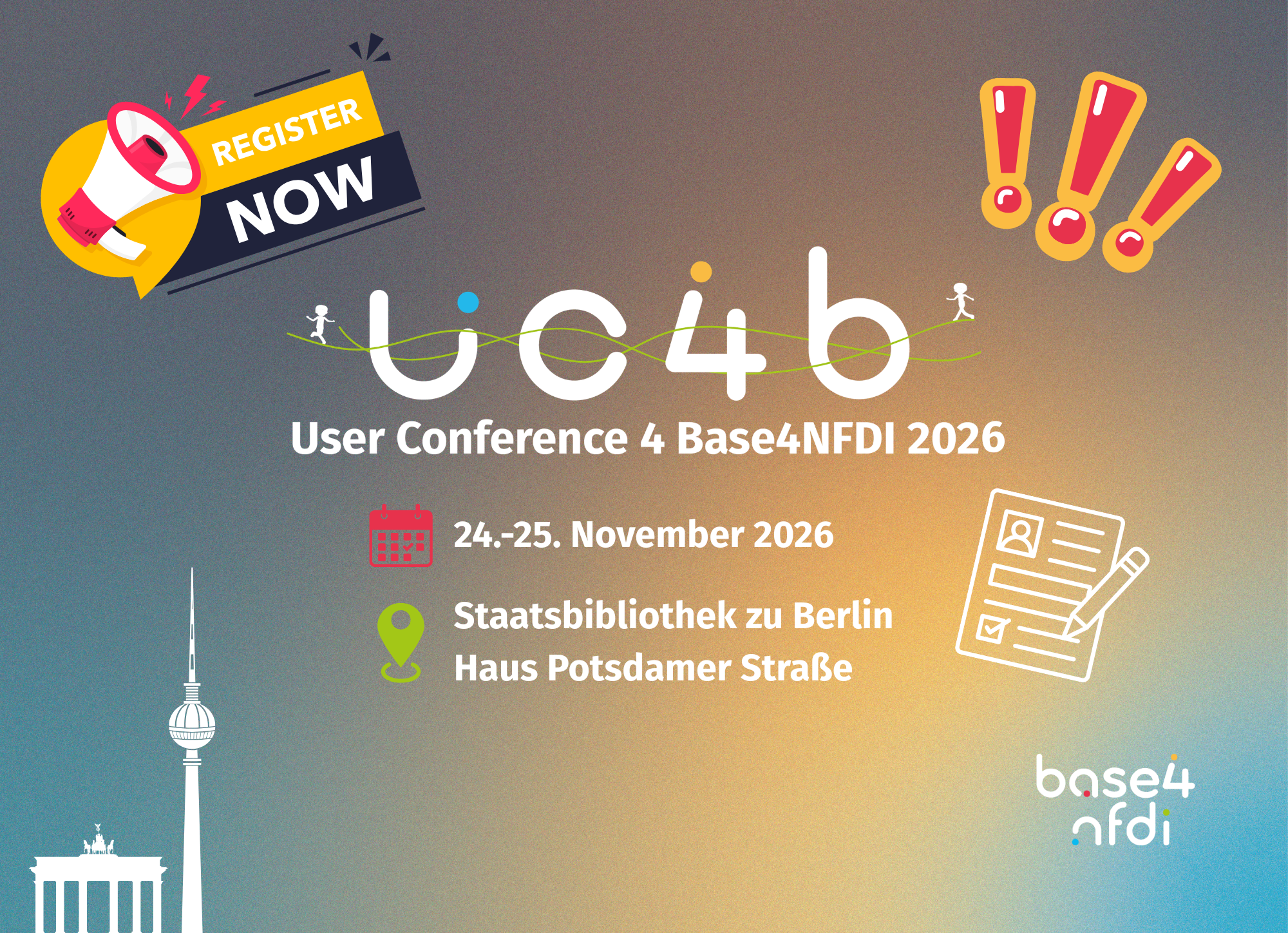
Whether you have been to one or even both of our User Conferences or not, we warmly invite you to register for this year’s event. It will be in Berlin at the Staatsbibliothek from 24 until 25 November. The focus will be on hands-on sessions as well as strategic discussions, e.g. on operating models for basic services. As in the previous years, participation is free of charge and we are very much looking forward to welcoming you. 
You can directly register here. Further information can be found on the event page.

And if you want to browse through the UC4B-related presentations, you can do so in our respective Base4NFDI Zenodo communities: UC4B 2024 and UC4B 2025.
Teaser BaseBirthdayCampaign UC4B


UC4B2026: Registration is now open

Teaser picture for regsitration opening of the UC4B 2026

2026-09-16

Join us for the 3rd Base4NFDI User Conference (UC4B 2026) on 24–25 November 2026 at the Staatsbibliothek zu Berlin.

Two days of exchange around basic services, practical experiences, community integration and the future of cross-disciplinary research data management – with contributions from across the NFDI and beyond.

The programme is now available – take a look and register herehttps://events.gwdg.de/event/1337/registrations/1091/

We look forward to seeing you in Berlin!

Base4NFDI Birthday Campaign - August 2026

Banner picture of the Base4NFDI Birthday Campaign in August

2026-08-24

In August, we shared information about another of our basic services: Jupyter4NFDI. In the summary below you will see what the team has been working on, what is usable already, and where you can find further resources and materials.

Juypter4NFDI – An introduction

Jupyter4NFDI is an online, browser-based Jupyter platform for researchers and users in the NFDI community. It gives you a place to run notebooks and work with data, simulations, or machine learning without needing to set up a full local environment first. On the team’s website you cannot only learn all about their intentions and recent progress, but it also points users to different JupyterHub services and helps them choose the right one for their needs. 

The service can be used via a JupyterHub that is hosted by Forschungszentrum Jülich (FZJ). For user authentication, Jupyter4NFDI relies on the NFDI Infrastructure Proxy. To log in and use the service, you have to select a suitable AAI from a list of options. Furthermore, the service… 

  • Lets you access Jupyter notebooks in the browser.
  • Connects you to cloud resources for data analysis, training, and computational work.
  • Supports reproducible research by making it easier to use the same environment across users and workshops.

To get started, you visit the hub, sign in with a supported identity provider, choose a system, and launch your workspace. The site is meant to make it simple to start working quickly, especially if you are part of an NFDI consortium or affiliated communities. 

Jupyter4NFDI also offers special tools for running workshops. Instructors can create controlled environments, manage participant access, share storage, and even allow tutors to join sessions for live help.

To sum it up… If you need a ready-to-use Jupyter environment for research, training, or collaborative data work, Jupyter4NFDI and its informative website are exactly what you are looking for. It focuses on making access easy, keeping setups consistent, and supporting both individual users and organised workshops. 

Conclusively, we want to draw your attention to our Demo Session (May 2026), where Jupyter4NFDI showed the progress they made so far.

Teaser picture of the Base4NFDI Birthday Campaign in August with an Introduction of Jupyter4NFDI

The JupyterHub & incubator projects

Like you read before, Jupyter4NFDI provides a federated JupyterHub that enables accessible, reproducible, and collaborative research workflows and connects resources from NFDI partners to a central NFDI JupyterHub. By connecting different computing resources through a central access point, the service simplifies the use of Jupyter environments while supporting FAIR and open science principles. A major advantage of Jupyter4NFDI is that it benefits not only researchers but also resource providers.

For researchers, Jupyter4NFDI offers a flexible environment for data analysis, teaching, and collaboration. Users can execute notebooks directly from code repositories, create shareable links to their work, collaborate with colleagues in real time, and run their own container images to tailor the environment to their specific needs. The platform also supports trusted training and teaching by providing configurable workshop environments and fostering a growing community that shares knowledge, best practices, and reusable resources.
Detailed information about how researchers can use Jupyter4NFDI can be found in their extensive documentation on https://nfdi-jupyter.de/

Resource providers benefit from a scalable architecture that allows them to connect their local computing infrastructure to the central Jupyter4NFDI Hub. Through the in-house developed JupyterHub Outpost, providers can integrate their resources while retaining control over their infrastructure. At the same time, they benefit from a centralised user management, reducing administrative effort and making their resources accessible to a broad research community. 

More information about the JupyterHub Outpost architecture, its installation and configuration can be reviewed here: https://nfdi-jupyter.de/providers/

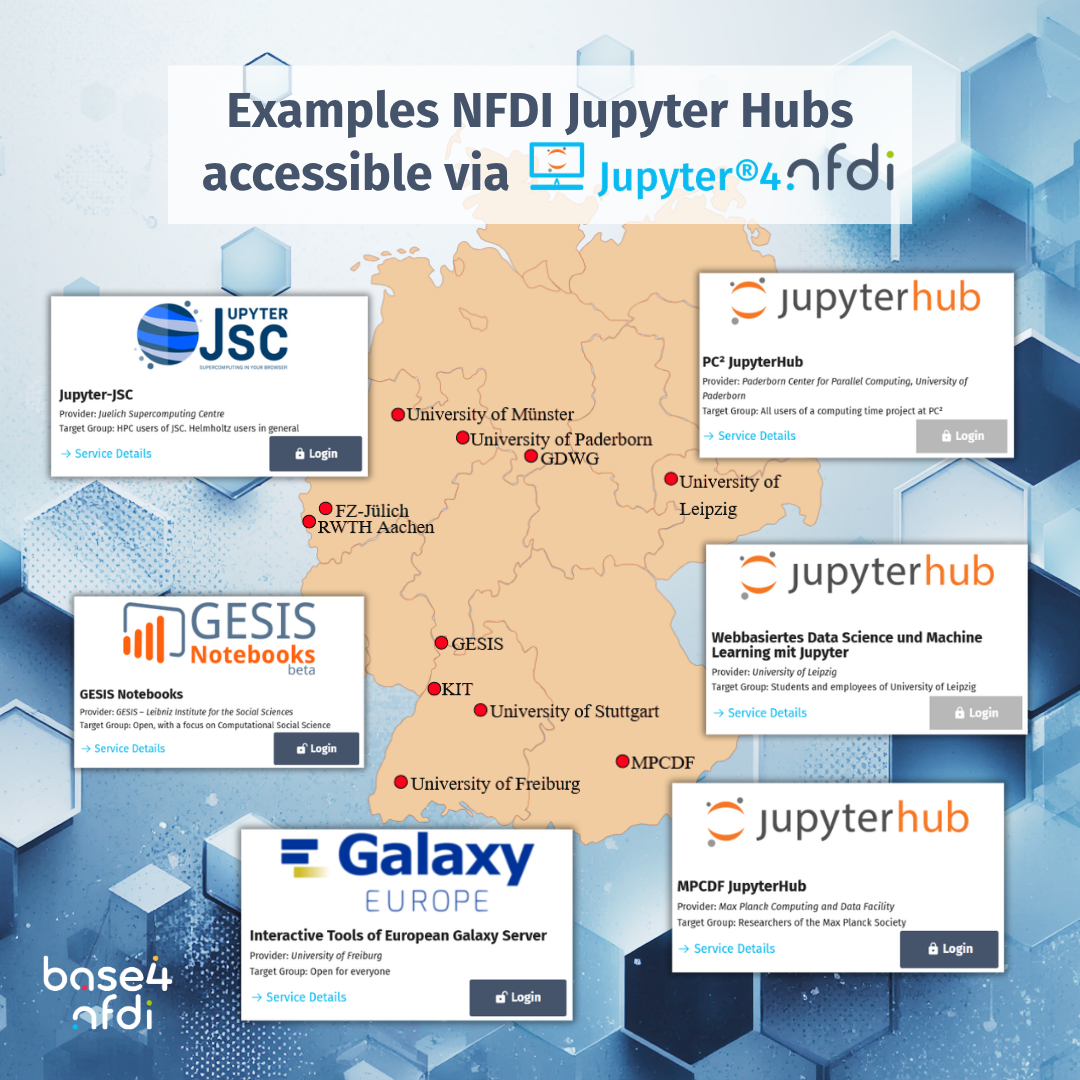
The fact that Jupyter Notebooks are a practical tool for researchers in various disciplines is demonstrated by the growing number of Jupyter Hubs already accessible via Jupyter4NFDI. Currently, 11 providers host 12 Jupyter services. A list of all NFDI JupyterHubs can be accessed here: https://nfdi-jupyter.de/hubs/ 

Furthermore, Jupyter4NFDI is adopted across multiple NFDI consortia like NFDI4DataScience, DataPLANT, NFDI4Bioimage and NFDI4ING, not only via its Hubs but also through Incubator projects. An example here is MONAPipe in Text+: https://textplus.pages.gwdg.de/collections/mona-pipe/. It provides natural-language-processing tools for German, implemented in Python/spaCy; additionally, MONAPipe adds specific custom components and models for Digital Humanities and Computational Literary Studies. Jupyter4NFDI, thus, enables users to directly access Python resources and workflows without the need for local software installations via accessing shared environments through JupyterHub instances. 

While this is only one example of a successful incubator project, we would like to point you to an overview of the service’s completed and ongoing incubators: https://github.com/NFDI-Jupyter/services/discussions 

And for some general information about the incubator endeavours, including an FAQ list, please visit: https://base4nfdi.de/projects/incubators 

Should you have any questions, do not hesitate to reach out to the team via This email address is being protected from spambots. You need JavaScript enabled to view it..

Teaser picture of the Base4NFDI Birthday Campaign in August about the Jupyter4NFDI Hubs

13th Base4NFDI Newsletter - August 2026

Teaser picture Base4NFDI Newsletter August 2026

2026-08-04

Welcome to the 13th Base4NFDI newsletter!
Every two months we will share the latest updates about upcoming Base-relevant events and presentations, insights into the basic service development, and notify you about interesting resources to keep you informed and inspired. 
Thank you for your support this year and being part of our community. 

Brief updates from the basic services

  • IAM4NFDI
    • All three project proposals are now available on Zenodo: Initialisation Phase, Integration Phase and Ramp-up Phase.
    • The following incubators are completed: Best practice AAI for BERD Data Portal, Forum 4 MICA and File Transfer Service FTS.
    • A new incubator project is in progress: NFDI-MatWerk Community Membership – Single Sign-on and Community Management with RegApp.
    • Join the monthly IAM4NFDI Sprint Demos, every month on its third Thursday, 9.00 - 10.30 am, Registration.
  • TS4NFDI
    • The team’s basic service proposal has been accepted for funding of the Ramp-up phase following the Consortia Assembly’s decision. The Ramp-up phase will start in January 2027.
  • PID4NFDI
    • The complete documentation and resources of the hands-on workshop on querying DOI metadata via the DataCite-API are now available via Zenodo.
    • Explore the new DataCite Linked Data resources, providing a persistent namespace and machine-readable representations of DataCite metadata terms to support semantic interoperability, mappings, and reuse. Access the resources here.
    • The NFDITalk: Introduction to PID4NFDI service components is now available on Youtube.
    • PID4NFDI invites you to their next virtual Open Hour which will take place on September 7 at 11:00 AM CEST. This session will focus on Data Type Registries (DTR) and how incorporating Data Typing as a Service—linked with initiatives like FAIRCORE4EOSC—helps standardise data types and enhance interoperability across NFDI repositories. You can find the access link here.
  • KGI4NFDI
    • The service started their Integration phase on August 1, 2026.
  • DMP4NFDI
    • More than 1000 DMPs in DMP4NFDI hosted RDMO clients.
    • 4 new Incubator Projects started in July:
      • Service Integration: The Incubator with RADAR, RADAR4Chem and RADAR4Culture aims to improve the integration of RDMO and the RADAR research data repository within the NFDI context
      • Template Development: NFDI4Chem as well as NFDI4ING are going to improve their DMP templates in order to enhance the standardisation and interoperability.
      • Training & Outreach: The incubator with NFDI4Health will help develop a training/tutorial for using the "Research Data Management Plan – Epidemiological studies" template while also providing an overview of DMPs and their relevance.
    • For more information, updates, and results of ongoing or completed incubators, please visit the Incubator Dashboard
    • New publication “Towards a common SMP for NFDI” is available on Zenodo.
  • Jupyter4NFDI
    • Jupyter4NFDI is now providing GPU resources.
    • Jupyter4NFDI provides a REST API to programmatically start and stop Jupyter servers. This allows you to integrate JupyterLab into automated workflows, scripts, or external applications.
  • RDMTraining4NFDI
    • The service team is back and started their Integration phase on August 1, 2026.
    • Save the Date for the RDMTraining4NFDI – Stakeholder Meeting Certification (1st Pilot-Phase & Experts) on November 6, 2026 (alternative slot: November 20, 2026) from 10am - 1 pm. Key topics, poll, link, and details will be announced soon.
  • Accounting4NFDI
    • Accounting4NFDI submitted their Integration Proposal on 22 July.
    • Accounting4NFDI is currently gathering feedback on the community’s needs. If you want to get in touch with the team about requirements in your consortium, please get in contact: This email address is being protected from spambots. You need JavaScript enabled to view it..
    • In the Demo Session on 28 July, Accounting4NFDI presented their project’s motivation and showcased their initial prototype. If you missed the Demo, you can have a closer look into the slides on our events website.

Updates from base4NFDI

  • The 12th submission round was closed and Base4NFI received one proposal from Accounting4NFDI for the Integration phase. 
  • Base4NFDI is finally part of the Fediverse. There we’ll post updates about Base4NFDI, our Basic Services, community events, and news from our framework. Follow us on https://nfdi.social/@base4nfdi and maybe leave us some nice welcome comments.
  •  Base4NFDI has launched the Service Support Track (SST), offering lightweight, targeted support for basic services through small to medium interventions such as workshops, external expertise, or travel. Support requests are based on the newly published Service Readiness Levels (SRL), a nine-level framework for assessing service maturity, together with a self-assessment template.
  • The next Fireside Chat will feature Federico Cetrangolo from LA Referencia on 13 October 2026, 15 - 15:45 CEST. You can register for the event here.
  • The Fireside Chat Interview with Rosie Hicks is now available on Youtube.

If you have any questions, please contact: This email address is being protected from spambots. You need JavaScript enabled to view it.


Base4NFDI Birthday Campaign - July 2026

Banner Base4NFDI Birthday Campaign July

2026-07-30

In July we informed about another of our basic services: Terminology Services 4 NFDI (TS4NFDI). In the summary below you will see what the team has been working on, what is usable already, and where you can find further resources and materials.

TS4NFDI Community Support

Firstly, we would like to highlight the fantastic news that the submission for the TS4NFDI Ramp-Up Phase has been approved by the Consortia Assembly. The service will enter the final phase of the Base4NFDI framework at the start of 2027.
During the Ramp-Up Phase, TS4NFDI will focus on establishing sustainable operational models and integrating its services into the long-term NFDI service portfolio. Activities include consolidating support, maintenance, monitoring, and analytics, while expanding terminology coverage and quality. The project will further promote integration into downstream services, engage with user communities through workshops and events, gather feedback for continuous improvement, and provide training resources.

At the moment, TS4NFDI is in their Integration Phase, which is expected to be completed by the end of the year. The goal of the Integration Phase is to further develop the service into a mature and functional solution that will have been adopted by an initial group of organisations and institutions for their day-to-day operations. TS4NFDI has made significant progress from concept to practical implementation and already provides a range of usable components, documentation, and community resources that support terminology management across the NFDI. 

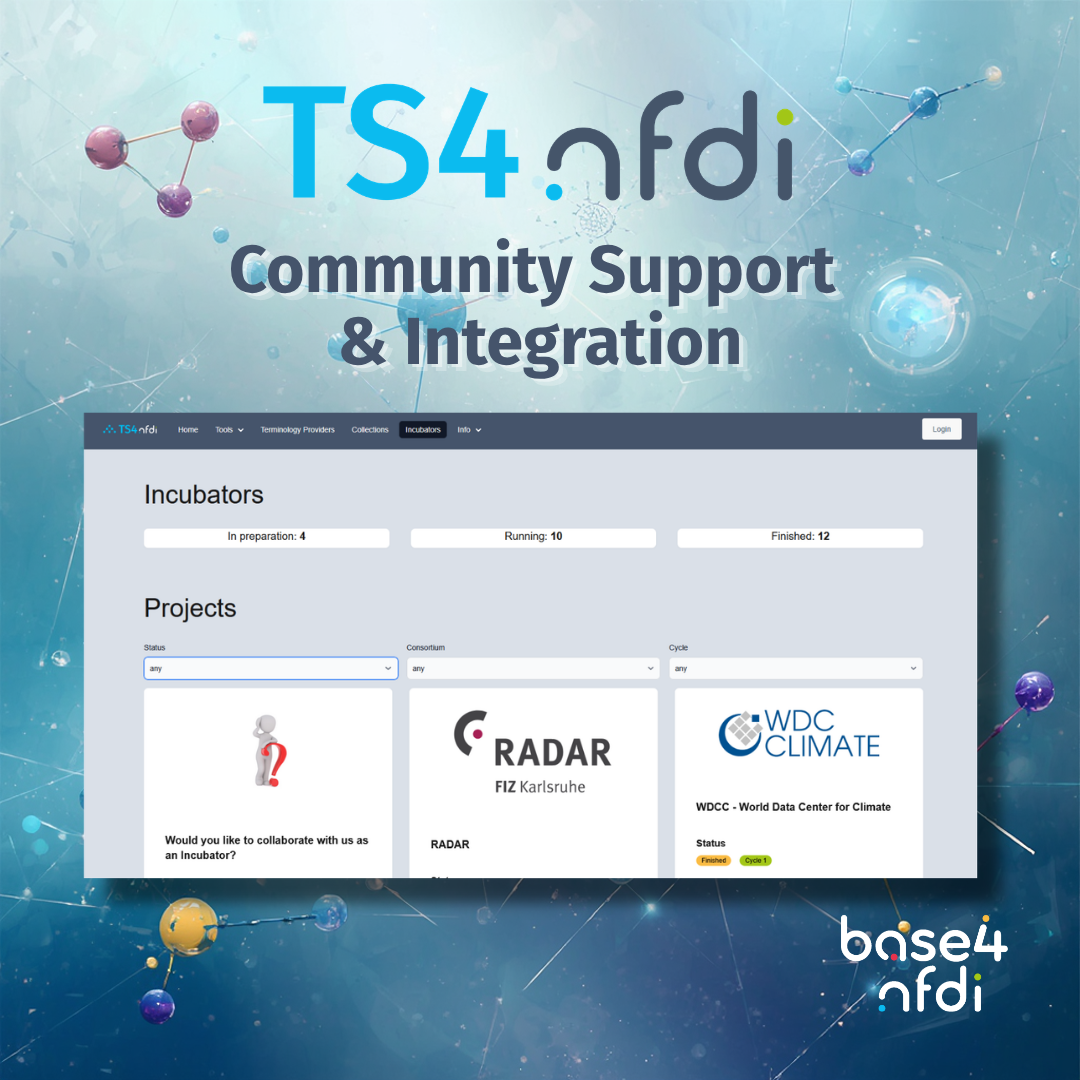
The increasing adoption of the service within NFDI is demonstrated through its incubator programme. Numerous incubator projects are already completed or currently in progress, supporting the integration of TS4NFDI into services and infrastructures from different consortia. A recent example is the successful integration of TS4NFDI into the RADAR repository and its disciplinary services such as RADAR4Chem, RADAR4Culture, and RADAR4Memory. Researchers can now use standardised terms of terminologies directly when describing datasets, resulting in more consistent metadata and improved interoperability and reusability. The ongoing incubator programme continues to increase the use of terminology services and their features across the NFDI landscape.  

Another important element of TS4NFDI is its community engagement. As you can see in their event calendar, the project regularly organises and participates in workshops, conference sessions, hackathons, and training events that introduce researchers and developers to terminology services and their practical application. These events not only promote awareness of the service but also provide valuable opportunities to collect user feedback and foster collaboration with NFDI consortia. Together with the publicly available documentation, publications, and incubator programme (see above), these activities have helped establish a growing user community and contribute to the increasing dissemination of TS4NFDI throughout the NFDI ecosystem.

Teaser picture Base4NFDI Birthday Campaign about TS4NFDI Community Engagement

TS4NFDI Service Portal

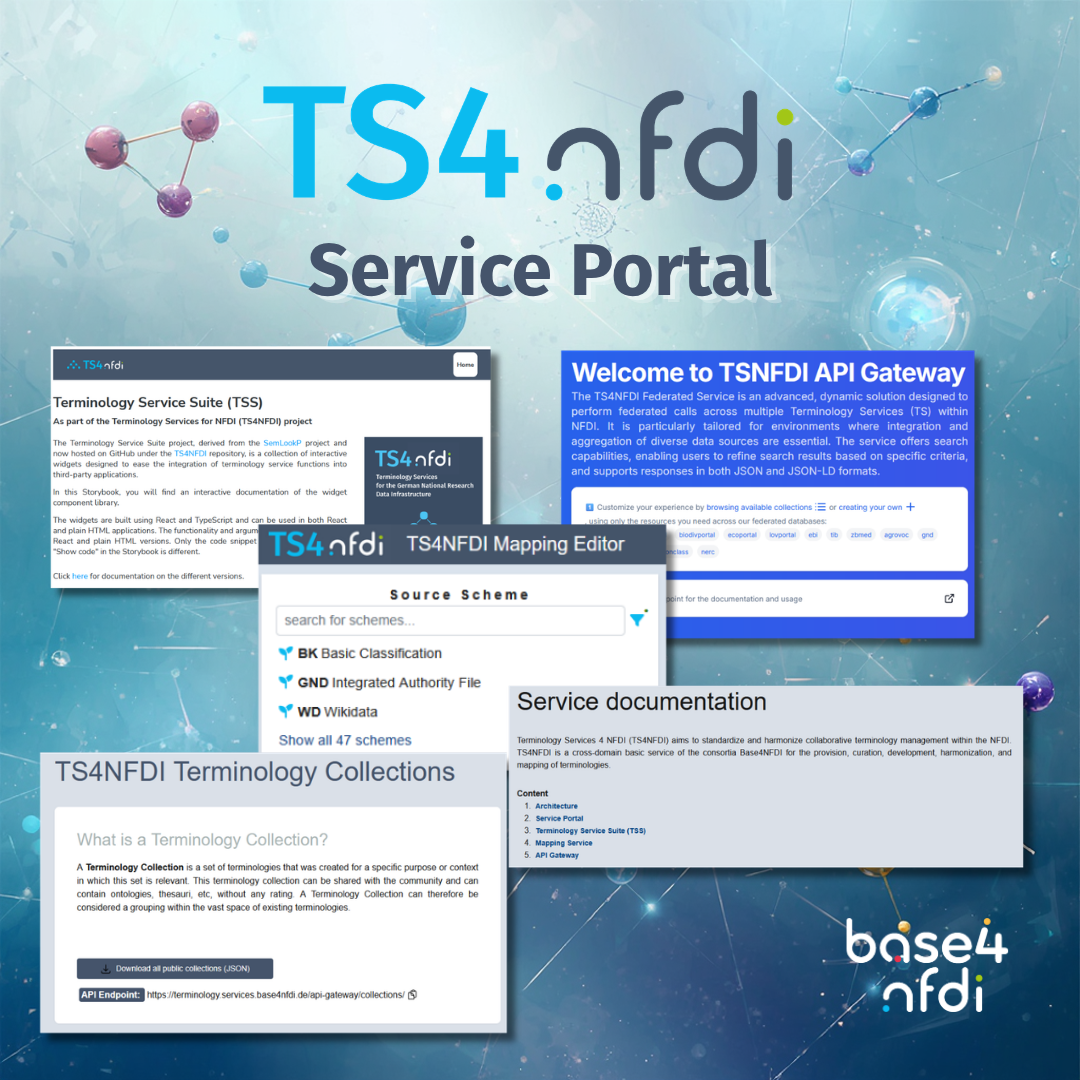
TS4NFDI has made significant progress in establishing a comprehensive terminology service network for the NFDI, with several core components already available to users. The service provides a central Service Portal that offers access to the widgets of the Terminology Service Suite (TSS), an centralised API Gateway, a NFDI-wide Mapping Service, and an overview of all available Terminology Collections (set of terminologies that were created for a specific purpose or context). Together, these components enable researchers and service providers to discover, harmonise, map, and integrate terminologies across disciplines while facilitating the seamless integration of terminology functionalities into third-party applications .

As an important part of its technical infrastructure, TS4NFDI also offers a broad range of supporting resources. Comprehensive documentation is available for all major service components, including the overall architecture, the Service Portal, the TSS, the Mapping Service, and the API Gateway. Developers can access detailed implementation guidance, API documentation, and widget descriptions, making it easier to integrate TS4NFDI functionalities into existing services. In addition, the project maintains a growing collection of publications, presentations, and software resources that document both the scientific background and practical implementation of the service.

To familiarise yourselves with TS4NFDI and its offers, we recommend you watch the following videos:

We hope you enjoy the videos and testing of the offers TS4NFDI already made available to this point. For feedback, questions, or ideas to collaborate, do not hesitate to reach out to the team directly using their contact form.

Teaser picture for Base4NFDI Birthday Campaign about TS4NFDI Portal